Swing Gate vs Sliding Gate for Driveway: Which One Is Actually Worth the Money?

The $2,800 swing gate looks like a steal — until you factor in the concrete work to level the driveway slope, the extra-heavy-duty hinges the budget installer skipped, and the service call six months later when the opener motor burns out from fighting a gate that was never properly balanced. When you’re weighing a swing gate vs sliding gate for driveway use at your Dallas home, the sticker price is the least useful number in the conversation. What actually matters is what you’ll spend over five years. As the team behind Dallas driveway gates installs and repairs across the metroplex, we see the downstream costs of rushed decisions every single season.

Why the cheapest gate option almost always costs more over five years


Here’s a real pattern we see constantly: a homeowner picks the lower quote, the installer uses builder-grade components, and within 18 months the hinges are sagging, the auto-reverse sensor is misfiring, or the track is warping. A single service call in the Dallas summer heat — diagnostics, labor, parts — typically runs $150–$350. Two or three of those in five years and you’ve already erased whatever you saved upfront.


A proper five-year total cost of ownership (TCO) for a driveway gate includes:


  • Initial hardware and installation
  • Automation system (operator, keypad, intercom)
  • Routine maintenance (lubrication, alignment checks, sensor calibration)
  • Unplanned repairs (motor replacement, hinge repair, track realignment)
  • Energy draw for motorized operation


When we build that picture for swing versus sliding gates at a typical Dallas property, the gap between them is smaller than most people expect — and sometimes the “cheaper” option ends up costing more in category 4 alone.

Looking for Professional Gate Repair You Can Depend On?

We provide prompt service and guaranteed quality. Call Now (972) 947-9559


How swing gates and sliding gates actually work (and why it matters for your property)

Before you can pick the right type, you need to understand what each system is actually doing mechanically. This isn’t trivia — the operating principle determines which problems you’ll face, how expensive they are to fix, and how long the system lasts.


Swing gates


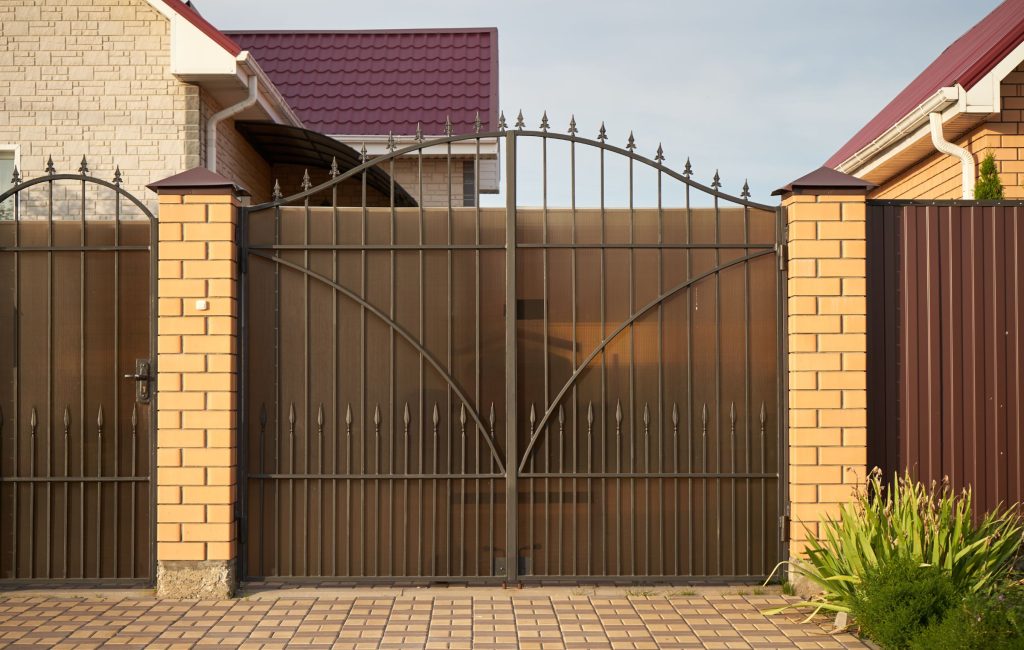
A swing gate operates on hinges anchored to posts on either side (or one side, for a single-leaf gate). When the operator activates, one or two panels arc outward or inward along a fixed radius. The mechanical stress concentrates at the hinge points and the operator arm. Swing gates are the older, more intuitive design — most people picture them when they think of an ornamental iron driveway gate.


The key vulnerability: hinge wear. In Texas, where temperatures swing from 25°F in January to 105°F in August, metal expands and contracts constantly. Cheap hinges loosen over two to three years. When hinges sag, the gate drags, the operator works harder, and the motor wears out faster. That cascade is the single most common repair scenario we handle.


Sliding gates


A sliding gate travels laterally along a track (or hangs from a cantilever rail if you want to avoid a ground track entirely). The motor drives a rack-and-pinion or chain mechanism that pulls the panel to one side. The panel itself stays upright — there’s no arcing motion, no hinge stress.


The trade-off is real estate: a sliding gate needs a clear run of space equal to the gate’s full width, plus a few feet of margin, along the fence line. A 14-foot sliding driveway gate needs roughly 15–17 feet of clear space on the opening side. If your property line, landscaping, or corner placement doesn’t allow that, sliding is simply off the table regardless of cost.

Which gate type fits your driveway layout?


This is the question we ask before any other. Layout constraints often make the decision for you, and that’s not a bad thing — it removes the paralysis.


Swing gates work best when:
  • Your driveway is level or has a very gentle grade (under 5%)
  • You have adequate setback from the street (the panels need room to swing inward without blocking traffic)
  • Your posts can be anchored in solid concrete footings
  • You prefer a traditional ornamental iron aesthetic


Sliding gates work best when:
  • Your driveway slopes noticeably — a slope that would cause a swing gate to drag or gap
  • You want faster open/close cycles (sliding operators typically move at 1–2 ft/sec vs. 0.5–1 ft/sec for swing)
  • You have limited setback from the street but ample lateral space along the fence
  • You’re securing a commercial or high-traffic entry where durability under frequent cycling matters


For a deeper look at how these designs fit different property types, our guide on types of gates for homes walks through the full range of options beyond just swing and slide.

What swing gates and sliding gates really cost in the Dallas area


Let’s put real numbers on the table. These are installed price ranges we see in the market — material, automation, and standard labor, without major concrete or grading work.


Swing gate installed cost


  • Single-leaf swing gate (10–12 ft), manual: $1,200–$2,200
  • Single-leaf swing gate with operator: $2,500–$4,500
  • Dual-leaf swing gate (12–16 ft) with operator: $4,000–$8,000+


The motorized gate cost rises quickly when you add a quality operator (LiftMaster, FAAC, or Viking) versus a no-name imported unit. Budget operators fail faster — we see them regularly, and replacement often costs more than upgrading to a name-brand unit would have originally.


Sliding gate installed cost


  • Sliding driveway gate, 12–14 ft, with operator: $3,500–$6,500
  • Cantilever sliding gate (no ground track), 12–14 ft: $5,000–$9,000+


The sliding driveway gate cost is higher upfront partly because the hardware is heavier and the installation is more involved. Cantilever systems — which eliminate the ground track entirely — cost more but last longer and handle debris (leaves, gravel, ice) far better than track-based designs.


Five-year TCO comparison (typical Dallas residential install)


Swing Gate


Sliding Gate


Install (mid-range)


$4,500


$5,500


Maintenance (5 yr)


$400


$300


Average repairs (5 yr)


$600


$350


Total


$5,500


$6,150


The swing gate wins on five-year TCO — if the site is suitable and the installation is done right the first time. If the driveway slopes or the hinges are undersized, add $800–$1,500 in corrective repairs and the gap disappears entirely.

Automation, sensors, and long-term maintenance: where the real trade-offs live


Both gate types can be fully automated — keypads, remotes, smartphone access, intercom integration. But the automation components interact with each gate type differently.


Swing gate operators use a linear actuator or articulated arm attached to the gate panel. The arm must be sized to the panel weight. We’ve replaced dozens of undersized arms on swing gates where the installer spec’d a 500 lb-rated arm on a 700 lb wrought iron panel. Understanding how automatic gate sensors work is worth your time before you finalize any purchase — a malfunctioning sensor that fails to stop a swinging gate panel does serious damage to vehicles and people.


Sliding gate operators are generally more forgiving of heavy panels because the lateral load is supported by the track or cantilever rail rather than the operator arm. They also tend to handle high-cycle use (apartment entries, commercial driveways) better over time.


Maintenance reality check:
  • Swing gates: lubricate hinges and operator arm pivot points every 6 months; check hinge bolt torque annually
  • Sliding gates with track: clean track monthly (Dallas has real dust and debris), lubricate rack quarterly
  • Cantilever sliding gates: lowest maintenance of all three configurations


For ongoing service across the DFW area — whether you need a tune-up or a full motor swap — our Dallas gate repair team handles both swing and sliding systems.

Frequently Asked Questions

Which gate type is more secure — swing or sliding?

Both can achieve the same security level when built from the right materials. The panel itself (wrought iron, steel tube, aluminum) matters more than the operating style. That said, sliding gates with a positive stop at the latch post are slightly harder to force open because there’s no hinge point to attack. For high-security applications, we typically recommend a cantilever slide with a heavy-duty lock post.

Can I automate an existing manual swing gate?

Often yes, but it depends on the post condition, hinge quality, and panel weight. We assess all three before recommending an operator. A post that’s shifted even an inch can prevent a linear actuator from operating smoothly. The cost of an electric gate retrofit typically runs $1,200–$2,500 installed, depending on the operator brand and any corrective work needed.

How much is a driveway gate for a standard suburban lot in Dallas?

For a fully automated single-entry gate on a standard residential lot, budget $3,000–$5,500 installed for a swing gate and $4,500–$7,000 for a sliding gate. Driveway gate prices vary based on panel material (ornamental iron costs more than aluminum), operator brand, and site conditions like slope or soil type.

Does a sloped driveway automatically rule out swing gates?

Not automatically, but it does raise the cost. Slopes under 3–4% can usually be accommodated with adjusted hinge positions. Steeper slopes require either significant concrete regrading or a switch to a sliding design. We always walk the site before quoting a swing gate on a sloped driveway.

What’s the cost of electric gates for driveways with intercom and camera integration?

Add $800–$2,000 to any base gate price for a complete access control package (keypad, intercom, camera mount, and wiring). The cost of driveway gate automation rises with the complexity of the access system, not just the gate type itself.


Ready to stop guessing and get a straight answer for your specific driveway? Metro Gate Repair has been installing, repairing, and maintaining swing and sliding gates across Dallas and the surrounding DFW communities for over a decade. We’ll walk your property, give you an honest comparison of what each option will actually cost you — not just today, but over the next five years — and back our work with a real warranty. Call us or request a free on-site quote today and let’s get the right gate on your driveway the first time.