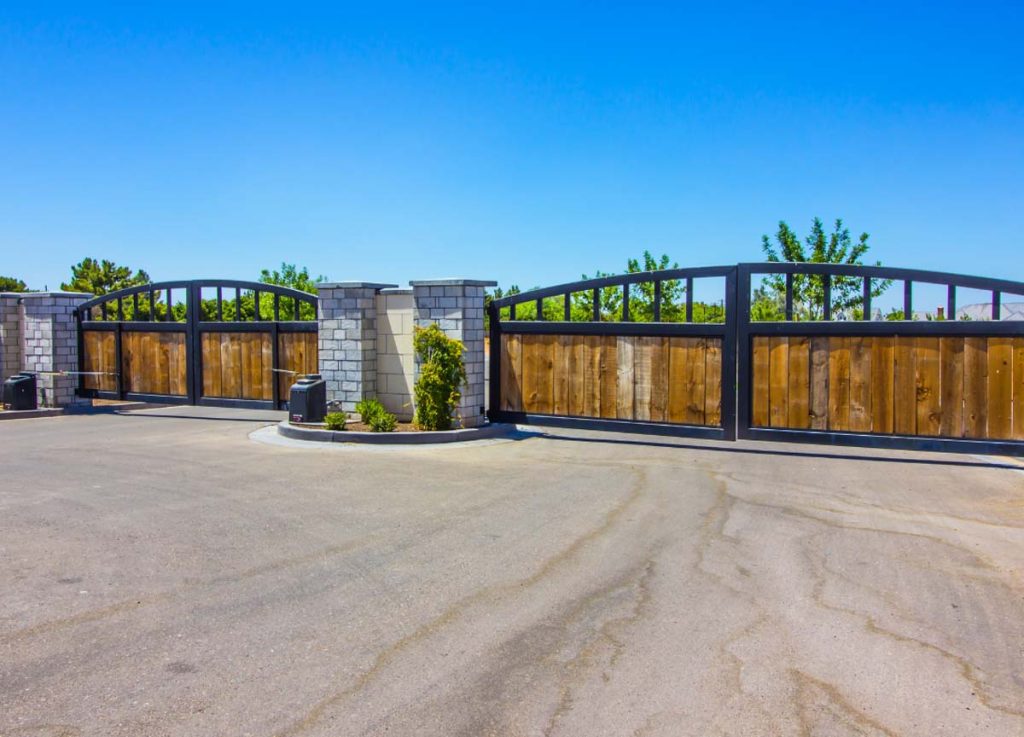
About 40% of the automatic gate service calls we handle trace back to one root cause: the wrong gate type was installed for the property in the first place. The operator burns out early, the hinges warp, or the track fills with debris — and the homeowner thinks they got a defective gate, when really the design was just a poor fit from day one. Choosing between a sliding gate vs swing gate for driveway use isn’t just a style decision; it directly determines how long your gate runs reliably and how much you’ll spend maintaining it over the next decade.
Why the Wrong Gate Type Fails Within 3 Years
We’ve been servicing driveway gates across the Dallas–Fort Worth area for over a decade, and the failure pattern is remarkably consistent. A homeowner installs a swing gate on a sloped driveway — the operator strains against gravity on every cycle, overheats, and the motor quits before the warranty even expires. Or someone puts a sliding gate on a property with loose, sandy soil; the track shifts over one hot Texas summer, the rollers bind, and suddenly the gate won’t close all the way.
Neither gate is inherently better. Both fail fast when they’re mismatched to the site. The root causes almost always fall into three categories:
Terrain mismatch — slope, soil type, or surface conditions the operator wasn’t designed to handle
Space assumptions — not accounting for the clearance a swing gate needs, or the run length a sliding gate requires
Operator overload — pairing a light-duty motor with a heavy iron gate, or cycling the gate far more times per day than the unit is rated for
Understanding these failure modes before you buy is exactly how you avoid them. Let’s look at how each gate type actually works — and where each one tends to break
How Sliding Gates Work — and Where They Break Down
A sliding gate travels horizontally along a track mounted at the base of the opening, or in some cases hangs from an overhead cantilever system. The operator (motor) drives a rack-and-pinion or chain mechanism that pulls the gate panel to one side.
Track-mounted sliding gates
This is the most common style for residential driveways. The gate rides on a wheeled carriage along a steel track embedded in or bolted to the ground. They’re a great fit for properties with a flat approach and enough clearance on one side to park the gate panel when it opens.
Where they fail: Dallas soil — particularly the expansive clay common throughout the metroplex — shifts noticeably between wet winters and dry summers. That ground movement torques the track over time. Once the track is even slightly out of true, the rollers wear unevenly, the gate drags, and the motor starts pulling amps it wasn’t built for. We see track-alignment repairs spike every spring after the heavy rain season.
Cantilever sliding gates
A cantilever gate hangs from overhead rollers and never touches the ground, which eliminates the track-shifting problem entirely. They cost more upfront but are significantly more reliable on Dallas clay soil. The tradeoff is that they need roughly 1.5 times the gate width in clearance behind the post to counterbalance the panel — so they don’t work on tight properties.
A sliding gate for fence installations is often the better option when you’re working with a long fence line and limited depth on the swing side. If your automatic fence runs along a busy Dallas street with no room for a gate to arc outward, sliding almost always makes more sense.
Looking for Professional Gate Repair You Can Depend On?
We provide prompt service and guaranteed quality. Call Now (972) 947-9559
How Swing Gates Work — and Their Most Common Weak Points
Swing gates operate like an oversized door, pivoting on hinges (or posts) and driven by an arm or underground operator. They come in single-leaf (one panel) or dual bi-parting (two panels that meet in the middle) configurations.
Single-leaf swing gates
Simpler mechanically, cheaper to install, and easier to repair. A single heavy panel works well on narrower openings — up to about 14 feet. Beyond that, the leverage on the hinge posts becomes a real problem, and you start seeing post lean within a year or two.
Dual bi-parting swing gates
The classic look for wider residential driveways and most commercial entrances. Each panel is shorter, so hinge stress is lower. The downside is twice the hardware — two operators, two sets of hinges, two limit switches — which means twice the potential failure points.
The single biggest killer of swing gates in our market is slope. If your driveway pitches downward away from the street, a swing gate that opens outward has to fight gravity every single cycle. The operator works harder, heats up faster, and typically fails two to three years earlier than its rated lifespan. We can sometimes compensate with a more powerful operator, but that raises costs and doesn’t fix the underlying physics.
Sliding Gate vs Swing Gate for Driveway: The Key Trade-Offs
Here’s how the two types compare across the factors that matter most for a Dallas driveway installation:
Factor
Sliding Gate
Swing Gate
Sloped driveways
Excellent — slope doesn’t affect operation
Poor — gravity fights the operator
Flat driveways
Excellent
Excellent
Tight side clearance
Poor — needs run-out space
Good — only needs arc clearance
Dallas clay soil
Moderate (track) / Good (cantilever)
Good — hinges aren’t ground-dependent
Wind load
Excellent — panel moves parallel to wind
Moderate — large panel acts as a sail
Maintenance frequency
Moderate (track/roller cleaning)
Low (hinge lubrication)
Motor replacement cost
Moderate
Moderate
Visual footprint
Minimal when open
Gate visible parked to side
One practical note on wind: North Texas sees serious gusts, especially during spring storm season. A wide swing gate acts like a sail when it’s caught open in a gust — we’ve straightened more than a few bent swing-gate arms after spring thunderstorms. A sliding gate, running parallel to the wind direction, is far less vulnerable to storm damage.
For anyone researching electric gates Dallas options, this comparison is equally relevant — the operator type (linear arm, underground, rack-and-pinion) layers on top of whatever gate style you choose
Which Gate Type Fits Your Dallas Property Best?
Here’s the honest shortcut we give every customer before quoting a job:
Choose a sliding gate if:
Your driveway slopes away from the street
Strong prevailing winds are a concern
You have at least 1x to 1.5x the gate width in side clearance
Your automatic fence line leaves no room for an outward arc
Choose a swing gate if:
Your driveway is flat or slopes toward the street
Side clearance is limited on both sides
You want lower upfront hardware cost
You prefer lower day-to-day maintenance (hinges vs. track)
Properties in areas like Frisco, McKinney, and north Dallas suburbs tend to have flat paved driveways with decent side clearance — swing gates work well there. Properties closer to the older neighborhoods near downtown Dallas, or lots with any significant grade change, almost always do better with a sliding setup.
No matter which type you pick, proper gate installation Dallas matters as much as the gate itself. A perfectly matched gate type installed on an out-of-plumb post or a poorly graded pad will still fail prematurely.
If your current gate is already struggling — dragging, reversing on its own, or failing to latch — that’s often a sign the original installation didn’t account for these site factors. Good driveway gate repair can extend the life of a mismatched setup, but at some point a properly spec’d replacement is the more cost-effective call.
Frequently Asked Questions About Driveway Gate Types
Can I switch from a swing gate to a sliding gate without replacing the posts?
Sometimes, but not usually. Sliding gates require a different post configuration and a track or cantilever system that a swing-gate post wasn’t built to support. In most cases we recommend new posts when converting types. The good news is that the operator, control board, and access hardware (keypads, remotes) can often be reused if they’re compatible.
How many cycles per day can a typical residential gate operator handle?
Most residential-grade operators are rated for 200–300 cycles per day. A cycle is one open-and-close sequence. If you run a home business with frequent delivery vehicles or a large family with multiple drivers, you can hit that limit faster than you’d expect. Commercial-rated operators start at 500+ cycles and are worth the upgrade for high-traffic driveways.
My sliding gate drags on one side — is that a track problem or an operator problem?
Usually both, but the track is the starting point. If the track has shifted or there’s debris packed under a roller, the gate will drag and the operator will compensate by pulling harder. Fix the track alignment first; if the motor is still sluggish or noisy after that, then look at the operator. Ignoring the track and replacing the motor first is one of the most common (and expensive) mistakes we see.
Do sliding gates work with automatic gate access systems like keypads and intercoms?
Yes — the access control hardware is completely separate from the gate style. Keypads, intercoms, loop detectors, and remote receivers wire into the operator’s control board the same way regardless of whether you have a sliding or swing gate. For a full rundown of what’s involved with automatic gates Dallas systems, we cover operator types and access options in detail.
How often should I service my driveway gate?
We recommend a full inspection and lubrication service once a year for residential gates. High-cycle properties (commercial, multi-family) should be serviced every six months. Catching a worn roller, a loose set screw, or low grease in the rack before it causes a failure typically costs a fraction of the repair bill that follows a breakdown.
If you’re still weighing your options or your current gate is already showing signs of trouble, give Metro Gate Repair a call. We serve the entire Dallas–Fort Worth area and can assess your driveway, recommend the right gate type, and give you a straight quote — no upselling, no guesswork. Request your same-day service call or free installation estimate today and let’s get your gate right the first time.